


The cryptocurrency market continues to face notable selling pressure, with several leading altcoins struggling to regain upward momentum after months of volatility. Sentiment remains fragile as investors weigh macro uncertainty, liquidity conditions and lack of sustained bullish catalysts. Although cyclical rebounds appear, most altcoins remain well below their previous cycle highs, reinforcing a cautious environment across the broader market.
A recent CryptoQuant report provides additional perspective on this dynamic. According to the analysis, retail investors appear to be under constant pressure to sell altcoins, especially as weak prices and negative sentiment dominate the headlines. Meanwhile, the data point to a more complex underlying picture. Despite the ongoing pressure, certain segments of the market are forming noticeable buying walls, indicating that demand has not completely disappeared.
Trading volume across altcoins has increased significantly since Ethereum hit its recent bottom, reaching levels that are difficult to directly compare to the previous cycle. This increase in activity, even while prices remain low, may reflect repositioning rather than pure capitulation. Importantly, most altcoins have yet to make a meaningful recovery, suggesting that the current buzz could represent accumulation, speculative positioning, or a combination of both as the market searches for trend.
Retail sector capitulation meets strategic crypto accumulation
CryptoQuant analysis suggests that much of the current altcoin selling pressure is driven by retail participants reacting defensively to volatility and prolonged drawdowns. Fear-driven liquidations often arise during uncertain phases, especially when liquidity is tight and price recovery lacks momentum. This behavior tends to amplify short-term weakness, especially across mid- and low-value crypto assets.
However, the same data suggests that part of this selling volume is systematically absorbed by larger or more patient market participants. This absorption dynamic typically reflects positioning rather than speculation, as buyers accumulate while sentiment remains fragile. Historically, such phases have preceded structural shifts in the market, although the timing remains uncertain and the results are not guaranteed.

Some analysts believe that the current cycle may be characterized by an unusually strong preparatory buildup compared to previous market phases. High spot volumes coupled with sustained volatility indicate capital turnover rather than direct exit from the market in certain sectors.
However, expectations about the future bull phase for altcoins being much stronger than the previous cycle remain speculative. Market structure, overall liquidity conditions, regulatory developments, and Bitcoin dominance will all influence whether these predictions come true. The data primarily supports a market undergoing a redistribution rather than a confirmed bullish reversal.
The altcoin market cap remains under structural pressure
The total crypto market cap excluding the top 10 assets continues to show continued weakness, reinforcing the view that the broader altcoin sector remains under structural pressure. The chart reflects a clear failure to maintain momentum after the mid-2025 rally, with capitalizations steadily declining since the last major peak. Recent price action shows that the market is hovering near $170 billion, which is well below previous highs and still trending lower.
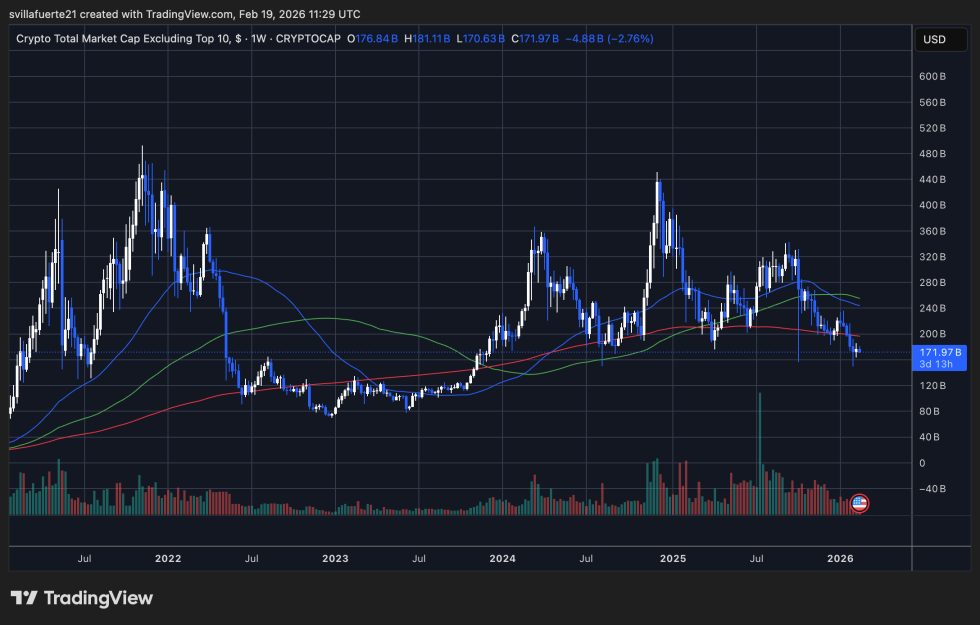
Technically, the structure looks fragile. The price has moved below the short-term moving averages and is testing long-term support areas. The inability to recover these averages indicates declining momentum rather than a consolidation phase. Large spikes in volume accompanying bearish movements also indicate that selling activity is still dominant, not just negative drift.
Historically, similar formations have occurred during late corrective phases when capital rotates back toward Bitcoin and larger capitalized assets. This usually reflects a reduction in risk rather than a direct exit from the market, but it still suppresses the performance of altcoins for long periods.
More importantly, the absence of strong recovery attempts suggests that liquidity constraints remain a major factor. Unless broader market sentiment improves or Bitcoin stabilizes convincingly, the altcoin sector may continue to face headwinds. At present, the data supports a continued redistribution rather than a confirmed cyclical bottom for the broader altcoin market.
Featured image from ChatGPT, chart from TradingView.com
Editing process Bitcoinist focuses on providing well-researched, accurate, and unbiased content. We adhere to strict sourcing standards, and every page is carefully reviewed by our team of senior technology experts and experienced editors. This process ensures the integrity, relevance, and value of our content to our readers.