

Here’s a question worth answering: Could a single £10,000 investment end up giving you £10,000 of passive income every year – and that’s without you even lifting a finger? I think it can. And the math, when you actually run it, is more compelling than most people think.
Let’s start with the important stuff. This is not a get-rich-quick idea. They always make mistakes. The strategy I’m talking about takes time, but that’s exactly the goal. Time is an element that most investors chronically underestimate.

Image source: Getty Images
Construction game
If I invested £10,000 today in a portfolio of high-quality stocks with a dividend yield of, say, 5%, I would receive £500 in the first year. I know this is a little frustrating. It’s less than £50 a month. I imagine most people won’t notice that.
But here the compound begins to do its quiet, relentless work. Invest in growth or profits, it doesn’t matter, as long as the returns are reinvested.
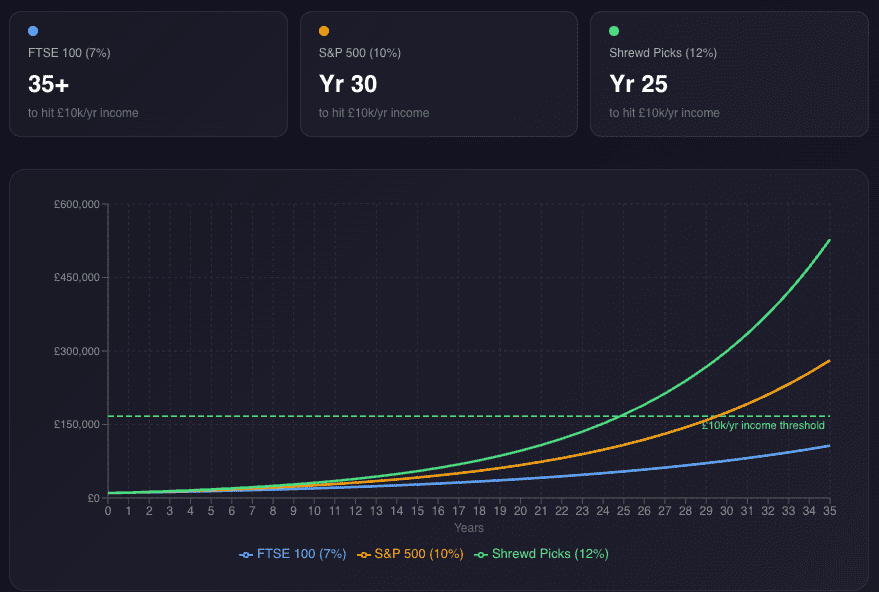
Over 25 years, at a blended total return of 12% per annum – not guaranteed, but achievable – the £10,000 swells to almost £170,000. At an income yield of 6% on this pot, we’re talking passive income of over £10,000 per year. From one initial investment.
Now, 12% per year is not the market average FTSE 100 index I have made approximately 7% to 8% including profits over the long term. But smart stock selection can fill this gap.
the Standard & Poor’s 500 It has averaged more than 10% per year over the past 30 years. Individual companies – such as high-quality companies with enduring competitive advantages – performed much better.
And remember, this can be achieved without adding anything to the principle. Contribute a little each month, and that final number will be reached much faster.
Where to invest?
Of course, as we mentioned above, we need to know where to invest. Smart investments can beat the market.
It could be one of these stocks TBC Bank (LSE: TBCG). It’s my favorite. The bank is one of two big players in Georgia, and also has operations in Uzbekistan – which has proven less smooth.
What attracts me is the evaluation. At a forward price-to-earnings ratio of just 5.4 and a price-to-earnings-to-growth (PEG) ratio of 0.5, the market is pricing in very little optimism about a business that is compounding revenues by more than 20% annually. Return on equity is 24.1%, operating margin is a generous 43%, and the forward dividend yield comes in at 6.35% – covered by roughly three times earnings. This is a useful source of income with room to grow.
Danger? Georgia’s economy relies heavily on employment in the service sector. The gray swan worth watching is AI-driven labor force displacement accelerating faster than the labor market can absorb it – suppressing demand for consumer credit and driving up bad debt. It’s not my primary condition, but it’s not nothing either.
However, this seems to be one of the most urgent investments in this sector. It’s definitely worth a look.