
The Flow Foundation asks a Seoul court to stop the delisting of FLOW from South Korea’s largest cryptocurrency exchange.
Flow fights back
In an announcement on March 8, the Flow Foundation and Dapper Labs (the Web3 project-backed company best known for creating CryptoKitties, NBA Top Shot, and other major NFT products) revealed that they had filed a request with the Seoul Central District Court to suspend the planned termination of FLOW trading on Upbit, Bithumb, and Coinone.
Cryptographic security concerns
On December 27, Flow suffered a protocol-level exploit that allowed an attacker to mint approximately 3.9 million duplicate tokens, resulting in an emergency downtime. Initial recovery proposals included a full rollback of the chain, which sparked opposition from partners over double balances and bridge losses; The team focused on “isolated recovery” that targeted and destroyed only counterfeit tokens.
Although users’ funds were not ultimately lost to the exchanges, the Korean platforms kept FLOW under close scrutiny. Upbit, Bithumb, and Coinone announced on February 12 that they would end trading support for FLOW on March 16, citing a protocol-wide exploit in December.
Security concerns are now resolved
However, all major global sites, including Binance, Coinbase, Kraken, and HTX, have now independently reviewed the incident and fully restored FLOW trading, with Binance even removing its monitoring flag following a joint decision on March 6. This confirms, according to the Flow Foundation and Binance itself, that “all issues related to the security incident have been resolved.”
“Commitment to Korea”
In Korea, Korbit (one of the oldest regulated cryptocurrency exchanges in South Korea, which focuses on spot trading of KRW for major currencies and retail users) conducted its own review, and Korbit removed the trading caution label on February 27, and continues to support unrestricted flow trading. The Flow Foundation expressed special gratitude for the Korean community’s continued support:
The Foundation recognizes the uncertainty that the Korean community has faced since February, and is grateful for the patience and support of Korean degree holders during this process.
Filing the application to the Seoul Central District Court is a step that “reflects the foundation’s responsibility to defend Korean society using all available means,” Flow claims. The Foundation also stressed that it “remains open to constructive dialogue with all parties concerned.”
Alongside this, the organization is seeking new listings and expanding self-custody options for on-premises users while moving forward with its consumer DeFi roadmap, including on-chain automation, EVM-equivalent infrastructure and an embedded lending protocol, betting that long-term adoption will outlast short-term regulatory frictions in a single market.
Growth of the flow ecosystem
While Korea grapples over FLOW’s listing status, the core network is quietly behaving like a top-tier consumer chain. Disney, the NBA, NFL, and Ticketmaster continue to build on Flow, together distributing more than 100 million NFTs to more than 13 million fans and generating billions in primary and secondary sales.
As Flow’s ecosystem momentum continues, the real question for investors watching the Korean court drama is whether a local delisting could really derail it.
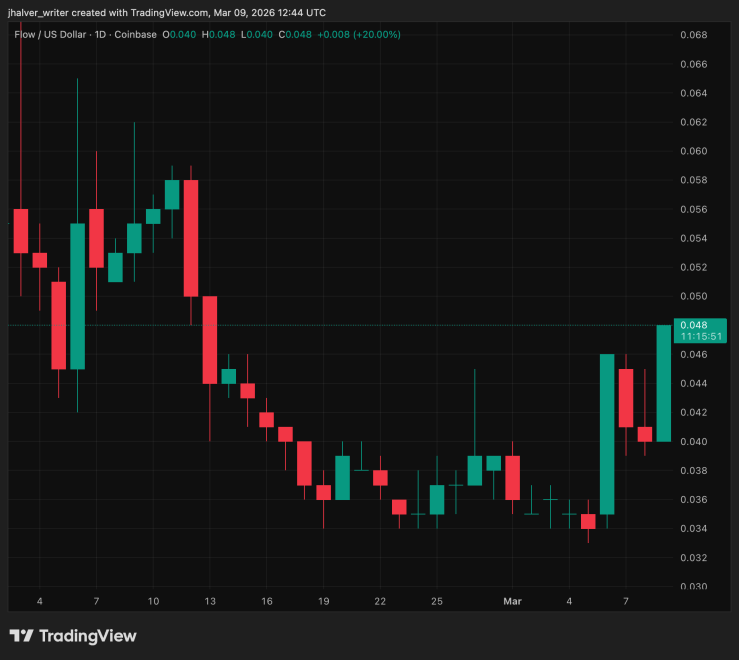
FLOW's price trends to the upside on the daily chart. Source: FLOWUSD on Tradingview
Cover image from ChatGPT, FLOWUSD chart from Tradingview
Editing process Bitcoinist focuses on providing well-researched, accurate, and unbiased content. We adhere to strict sourcing standards, and every page is carefully reviewed by our team of senior technology experts and experienced editors. This process ensures the integrity, relevance, and value of our content to our readers.