
[ad_1]

US-based Bitcoin ETFs recorded net inflows of $532.21 million on Monday, as Bitcoin fell above the $80,000 mark amid improved risk sentiment following the US-Iran ceasefire agreement.

BlackRock’s iShares Bitcoin Trust (IBIT) led the pack with $335.49 million in daily inflows, followed by Fidelity’s Wise Origin Bitcoin Fund (FBTC) with $184.57 million, according to SoSoValue data. Morgan Stanley’s Bitcoin ETF (MSBT) was the only other fund to record positive inflows on the day, adding $12.16 million. The remaining funds did not record any new inflows.

Monday’s inflows continued a three-day winning streak. On Friday, it raised $629.73 million, while Thursday saw a modest $14.76 million. The streak came after three straight days of outflows as funds lost $490.63 million, the longest sustained recovery period in recent weeks.
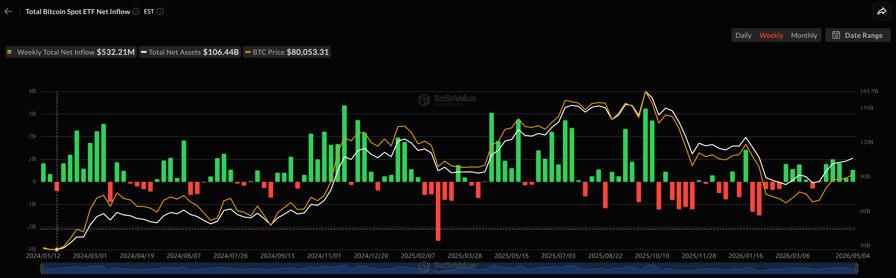
Spot weekly flows of Bitcoin ETFs. Source: Soso Value

The increased flow comes as Bitcoin rises above $80,000 for the first time in more than three months. The leading cryptocurrency is currently trading at around $81,029, up 1.5% from the last day, according to data from CoinMarketCap.

Related to: Bitcoin ETFs Crash for Nine Days as BTC Drops Below $77K

Bitcoin recovers $80,000 after rebounding after ceasefire

In a recent note, Bitonex analysts said the rise comes as Bitcoin continues to extend its “post-ceasefire recovery in risk appetite.” According to the analyst, BTC has reclaimed the key psychological level of $80,000 following a short-term concentrated liquidity squeeze in the $79,500-$81,000 range, with the $77,000-$78,000 area now acting as key support for leveraged buy trades.

However, the bigger picture is more complex, Bitunix analysts said, adding that macro and geopolitical forces are increasingly driving cryptocurrency price movements. The US military’s launch of “Operation Freedom”, which deployed 15,000 soldiers to secure shipping lanes through the Strait of Hormuz, caused nerves, with Iran warning that the move might violate the existing ceasefire framework.

Meanwhile, this week’s US non-farm payrolls report and Fed comments are expected to broadly set the tone for risk assets. If inflation expectations remain high, the Fed may keep interest rates higher for longer, putting pressure on cryptocurrency valuations. On the other hand, softer data could lead to a return to technology and digital assets.

“In general, Bitcoin is no longer solely driven by internal cryptocurrency market sentiment, but has entered a phase of being jointly priced by ‘macro events + liquidity structure,’” the analyst said.

Related to: Bitcoin ETFs Record Strong Inflows in April as Ether Turns Positive

Ethereum ETFs rebound

Ethereum spot ETFs also saw net inflows of $61.29 million on Monday. This followed a stronger session on Friday, which brought in about $101.18 million, helping push cumulative net inflows past $12 billion.

The new streak comes as late April saw notable outflows, including $87.73 million on April 29 and $75.94 million on April 23, along with smaller negative days like April 28 and April 30.

Asia Express: North Korea denies hacking cryptocurrencies, Upbit Bank tests Ripple

Cointelegraph is committed to independent and transparent journalism. This news article was produced in accordance with Cointelegraph’s editorial policy and aims to provide accurate and timely information. Readers are encouraged to verify information independently.

[ad_2]

The recent surge in spot Bitcoin ETF inflows signals a strong resurgence of institutional confidence in the cryptocurrency market. As Bitcoin reclaims the $80,000 mark, investors are once again paying close attention to digital assets as a viable and potentially lucrative component of diversified portfolios. The $532 million inflow into spot Bitcoin ETFs reflects not only renewed optimism but also a broader shift in how traditional finance interacts with the crypto ecosystem.

One of the key drivers behind this momentum is the growing acceptance of Bitcoin as a mainstream financial asset. For years, skepticism and regulatory uncertainty limited institutional participation. However, the approval and increasing popularity of spot Bitcoin ETFs have created a bridge between conventional financial markets and the world of cryptocurrencies. These ETFs allow investors to gain exposure to Bitcoin without directly holding the asset, reducing complexities related to custody and security.

The $80,000 price milestone is psychologically significant. Round numbers in financial markets often act as key resistance or support levels, influencing investor behavior. Bitcoin crossing this threshold again reinforces bullish sentiment and suggests that the market is entering a new phase of growth. This price recovery follows periods of volatility, demonstrating Bitcoin’s resilience and its ability to bounce back from downturns.

Institutional investors play a crucial role in this dynamic. Unlike retail traders, institutions typically bring large volumes of capital and a longer-term investment horizon. The recent $532 million inflow indicates that these players are not just testing the waters—they are actively committing resources. This level of participation adds stability to the market and reduces the likelihood of extreme short-term fluctuations.

Another important factor contributing to this trend is macroeconomic conditions. In an environment where inflation concerns persist and traditional assets face uncertainty, Bitcoin is increasingly viewed as a hedge. While it may not yet have the same status as gold, its digital nature and limited supply make it attractive to investors seeking alternatives. Spot Bitcoin ETFs make it easier for institutions to incorporate this hedge into their strategies.

The structure of spot ETFs also enhances transparency and trust. Unlike futures-based ETFs, which can suffer from issues like contango and tracking errors, spot ETFs are directly backed by Bitcoin. This means their value closely reflects the actual market price of the cryptocurrency. For investors, this alignment reduces risk and improves confidence in the product.

Retail investors are also indirectly benefiting from this trend. As institutional money flows into Bitcoin through ETFs, it contributes to price appreciation, which can boost the overall market. Additionally, the legitimacy conferred by institutional participation encourages more individuals to explore cryptocurrency investments. This creates a positive feedback loop, where increased demand drives further growth.

However, it is important to approach this development with a balanced perspective. While the inflows and price recovery are promising, the cryptocurrency market remains inherently volatile. External factors such as regulatory changes, technological developments, and global economic shifts can quickly alter market conditions. Investors should remain cautious and avoid making decisions based solely on short-term trends.

Regulation continues to be a critical aspect of the crypto landscape. The approval of spot Bitcoin ETFs in various jurisdictions marks progress, but regulatory frameworks are still evolving. Governments and financial authorities are working to strike a balance between encouraging innovation and protecting investors. Future regulatory decisions could either accelerate or hinder the growth of Bitcoin ETFs and the broader market.

Another consideration is market maturity. As more institutional players enter the space, the behavior of Bitcoin may gradually change. Increased liquidity and participation could lead to reduced volatility over time, making it more comparable to traditional assets. At the same time, this shift might also impact the high-return potential that has historically attracted many investors.

Technological advancements within the blockchain ecosystem also play a role in shaping market dynamics. Improvements in scalability, security, and usability enhance the overall value proposition of cryptocurrencies. As these technologies evolve, they strengthen the foundation upon which Bitcoin and related financial products, such as ETFs, are built.

Looking ahead, the future of spot Bitcoin ETFs appears promising. Continued inflows could drive further price appreciation and solidify Bitcoin’s position as a mainstream investment asset. Financial institutions may expand their offerings, introducing new products and services that cater to a growing demand for digital assets. This evolution could redefine the relationship between traditional finance and the crypto world.

In conclusion, the $532 million inflow into spot Bitcoin ETFs, coupled with Bitcoin reclaiming the $80,000 level, marks a significant moment in the cryptocurrency market. It reflects growing confidence, increased institutional participation, and a shift toward broader acceptance of digital assets. While challenges and uncertainties remain, the current trend suggests that Bitcoin is becoming an integral part of the global financial landscape. Investors, both institutional and retail, will be closely watching how this story unfolds in the coming months.


Leave a Reply

Your email address will not be published. Required fields are marked *