


Bitcoin is showing renewed strength after reclaiming the $70,000 level, a move that helped stabilize sentiment after weeks of extreme volatility and uncertain market direction. The recovery comes as several structural indicators begin to shift in favor of a more positive market environment, indicating that the recent correction may move into a new phase.
According to Axel Adler’s analysis, several systemic and structural indicators moved into positive territory simultaneously for the first time in nearly three months. The report highlights the behavior of Bitcoin System Score, an aggregate measure that includes several market variables, including borrower imbalance, open interest pressure, funding rates, ETF flows, exchange flows, and price direction. The score is normalized on a scale ranging from -100 to +100 to identify shifts in market systems.
On February 7, the system’s score dropped to -47, marking the deepest downward reading recorded over the past year. For comparison, the market bottom in November 2025 hit -37 and needed 33 days to recover to neutral territory, while the August low of -35 reversed in just 11 days.

However, in the current cycle, recovery occurred in about 25 days. As of March 4, the index has risen again to around +0.98, indicating a potential shift away from the recent bearish regime.
Structural indicators are aligned as Bitcoin tests key resistance
Adler further notes that price-based structural signals are now in line with system indicators, reinforcing the importance of Bitcoin’s recent rebound above $70,000. One of the key metrics highlighted in the report is the Structural Shift Composite, which is a quick signal designed to capture short-term changes in market structure.
The Structural Shift Composite ranges from -1 to +1 and includes several components of price behavior, including momentum, the sequence of price movements, and the position of the asset relative to its exponential moving averages. At the same time, the Donchian Channel provides a framework for identifying current technical limits, placing resistance near $73,698 and support at around $62,981.

Earlier in the session, the relationship between these indicators followed a different pattern. In January, the structural shift signal crossed above zero in one sharp move – from -0.05 to +0.57 – on January 2, but only after the system points had already been in the bullish zone for several days. This confirmation was followed by a rally that eventually pushed Bitcoin towards the $97,000 region.
The current transformation has developed differently. Between March 2 and 4, both the structural shift and system points crossed into positive territory simultaneously. With the structural shift now approaching +0.56 and the system points at +0.98, this synchronized shift suggests that the recent move towards $73K may represent a broader structural shift rather than a temporary short squeeze.
Bitcoin is trying to recover above long-term support
The weekly chart shows Bitcoin trading near $72,800 after a rebound from a sharp correction that pushed the asset below the $65,000 area earlier in 2026. After a prolonged rally that carried BTC above $110,000 in late 2025, the market entered a corrective phase marked by lower highs and increased volatility.
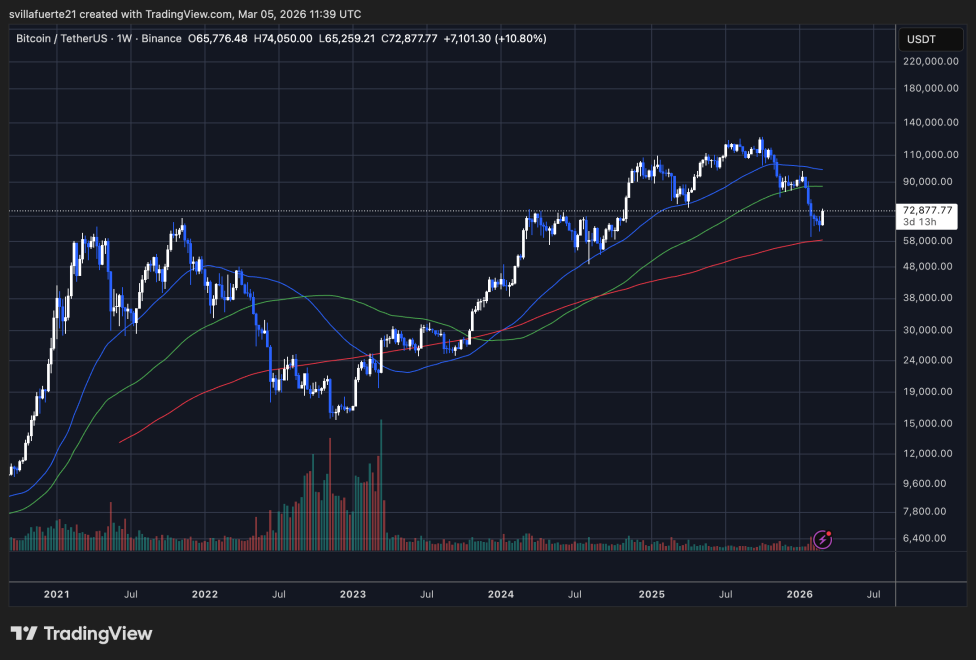
The recent decline briefly forced Bitcoin below its 50-week moving average, a level that has served as dynamic support throughout most of the bull cycle. However, the latest weekly candlestick suggests that buyers are trying to reclaim this level, which is now near the $70,000 area. Staying above this area is technically important, because it often serves as a structural pivot during mid-cycle consolidations.
Below the current price, the 100-week MA is located around the mid-$60,000 region, while the 200-week MA continues to trend higher near the high-$50,000 region. These levels form a broader long-term support group that can help stabilize the price should volatility return.
From a structural perspective, Bitcoin remains in an overall uptrend despite the recent correction. The market is now trying to form a higher bottom compared to the advance in 2024-2025.
If Bitcoin manages to consolidate above $70,000, the next resistance area could emerge near $85,000, where the previous collapse accelerated earlier this year.
Featured image from ChatGPT, chart from TradingView.com
Editing process Bitcoinist focuses on providing well-researched, accurate, and unbiased content. We adhere to strict sourcing standards, and every page is carefully reviewed by our team of senior technology experts and experienced editors. This process ensures the integrity, relevance, and value of our content to our readers.