


The supply structure of Bitcoin is undergoing a significant shift network The distribution factor (NDF) is declining rapidly. While price action often dominates the headlines, shifts in distribution metrics can reveal structural changes. The lower NDF indicates that the balance of BTC holdings across different wallet combinations is evolving, possibly indicating a redistribution of market participants.
What a network distribution factor actually measures
Advanced on-chain data analytics company, Alphractal, male On the X that Bitcoin’s NDF is falling sharply, it reveals an important structural shift in how asset supply is distributed across the market. NDF measures the proportion of the total BTC supply held by larger holders who control at least 0.01% of the total circulating supply.
When the metric decreases, it indicates that the concentration of BTC supply among large holders is decreasing. In practical terms this is Converts It represents a decrease in the relative dominance of large holders over the total supply and a broader redistribution of BTC among smaller participants and new market entrants.
Severe concentration declines are often observed during early accumulation phases, and a natural redistribution process follows periods of strong accumulation by large entities. Historically, extended declines in NDF tend to occur during stages when the market is mature and assets are more widely distributed.
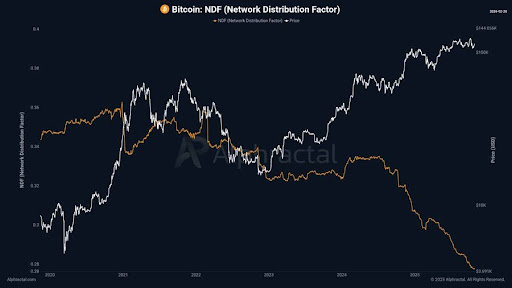
This often happens after major bull cycles, when big players accumulate supply and are gradually absorbed by the broader market market. Rather than signaling weakness, this dynamic could promote Bitcoin’s economic decentralization and reduce the structural risks associated with excessive concentration.
At the same time, it reflects a transitional phase in which supply is being redistributed globally, promoting Bitcoin’s evolution from a relatively concentrated asset into a widely distributed global financial network. However, this does not indicate Structural weaknessRather, it indicates the maturity and expansion of the BTC ownership base.
Why is Bitcoin a real financial revolution?
The most obvious reasons why Bitcoin remains the most compelling asset of our generation is its ownership structure and fixed supply. According to As for Crypto Battle, approximately 63% of the total circulating supply is held by ordinary individual participants, not Wall Street, the government, or even institutions.
At the core of this thesis, there are only 21 million Bitcoins in existence, and the number is permanently fixed; No central bank can amplify it, no politician can change the law, and no company can dilute its shareholders.
In a world of aggressive money printing and currency depreciation, Bitcoin stands alone as an algorithmically imposed scarcity, and the majority of these assets are owned by private individuals. Crypto Patel is framing decentralized and immutable ownership of BTC Supply Not just as a technology, but as a structural revolution.
Featured image from Getty Images, chart from Tradingview.com
Editing process Bitcoinist focuses on providing well-researched, accurate, and unbiased content. We adhere to strict sourcing standards, and every page is carefully reviewed by our team of senior technology experts and experienced editors. This process ensures the integrity, relevance, and value of our content to our readers.