


Democratic Senator Elizabeth Warren questioned Meta CEO Mark Zuckerberg about the company’s plans for stablecoins, warning of serious risks to financial stability, competition, privacy and the integrity of payments.
Stablecoin meta experiments under the microscope
US Senator Elizabeth Warren this week sent a new letter to Meta founder and CEO Mark Zuckerberg, raising concerns about the company’s plans to integrate stablecoins into the platform.
In the letter, the ranking member of the Senate Banking Committee highlighted recent reports suggesting that Meta was conducting a “small, focused” experiment with a third-party stablecoin and that the company plans to begin integrating it in the second half of this year.
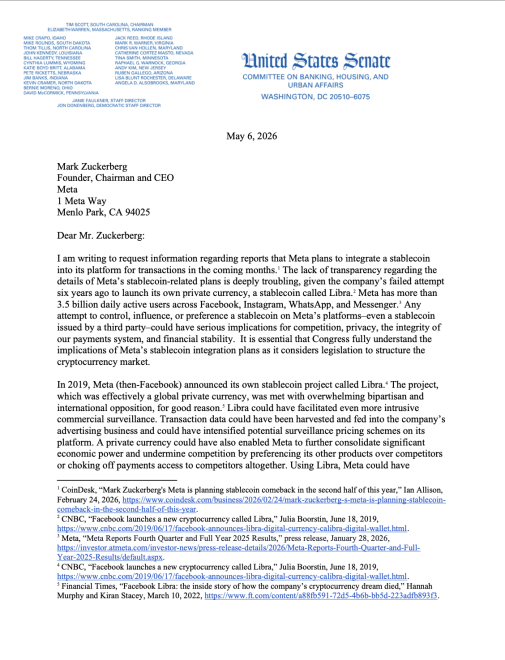
Warren's letter to Meta's Zuckerberg. Source: Senate Banking Committee
As reported by Bitcoinist, Meta began rolling out USDC payouts to select creators in Colombia and the Philippines last month, using Solana and Polygon as blockchain-backed rails.
Warren emphasized that it is “essential” for the US Congress to fully understand the implications of Meta’s integration plans as it considers the cryptocurrency market structure bill, the CLAIRTY Act.
“Any attempt to control, influence, or favor a stablecoin on meta platforms — even if it is a stablecoin issued by a third party — could have serious implications for competition, privacy, the integrity of our payments system, and financial stability,” she said.
The senator also raised concerns about a lack of transparency, underscoring Meta’s failed attempt to launch its own stablecoin six years ago. For context, the company announced its Libra project in 2019, but it was eventually shut down in 2022 after massive pressure from US regulators and politicians.
“It is important for Meta to be transparent with Congress and the public regarding its stablecoin plans. Beyond the failure of its previous attempt to issue its own global currency, the company has struggled to safely deliver its existing products and services (…). It stated that any new products, especially related to payments and financial services, should be treated with suspicion.”
The Warren probe intensifies
The latest investigation comes on the heels of a June 2025 letter in which Warren and Senator Richard Blumenthal questioned Meta about reports that the company was renewing efforts to launch a private currency project.
At the time, the senators asserted that Big Tech companies issuing or controlling private currencies would threaten competition across the economy, erode financial privacy, and cede control of the US money supply to “monopolistic platforms with a history of abusing their power.”
Days ago, Warren warned that the GENIUS Act, the landmark stablecoin bill, includes a major loophole that would allow big tech companies like Meta to re-enter the space with minimal oversight.
As the Senator noted in her recent letter, the company’s initial response confirmed that there was no stablecoin issued by Meta, adding that it had no plans to issue one in the future. Given recent reports, it has now pressed for details on the integration plan by May 20, including the nature of the meta trial and the roadmap for a potential launch in the second half of 2026.
Furthermore, it requested information on whether the company has chosen or will choose a third-party stablecoin, whether it intends to make any changes to the MetaPay wallet, how Meta has strengthened its illicit financial controls, what privacy guardrails it has put in place prior to the integration, and whether it still has no plans to issue a stablecoin.
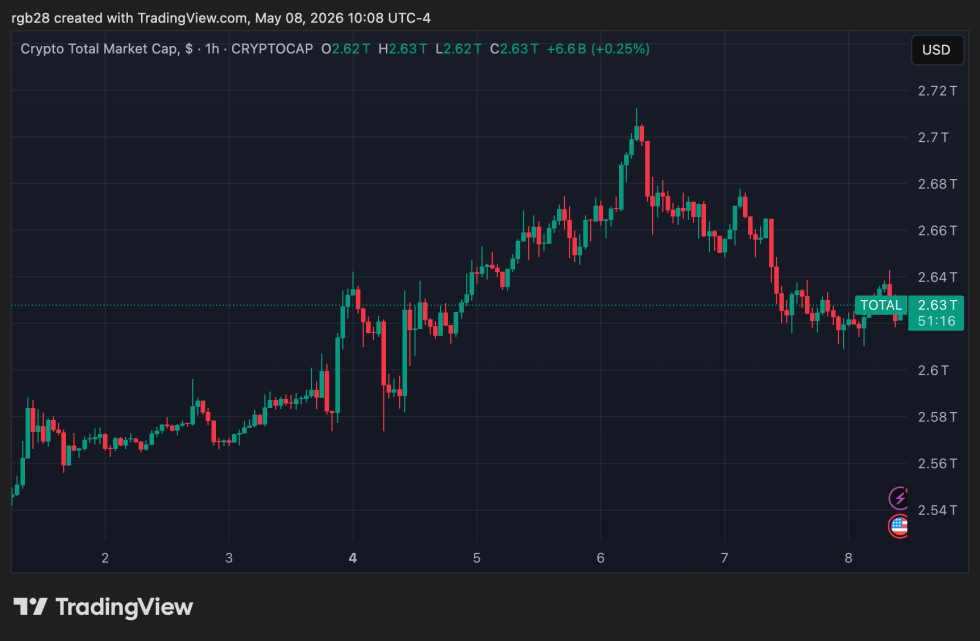
The total crypto market capitalization is at $2.63 trillion in the one-week chart. Source: TOTAL on TradinView
Featured image from Unsplash.com, chart from TradingView.com
Editing process Bitcoinist focuses on providing well-researched, accurate, and unbiased content. We adhere to strict sourcing standards, and every page is carefully reviewed by our team of senior technology experts and experienced editors. This process ensures the integrity, relevance, and value of our content to our readers.