
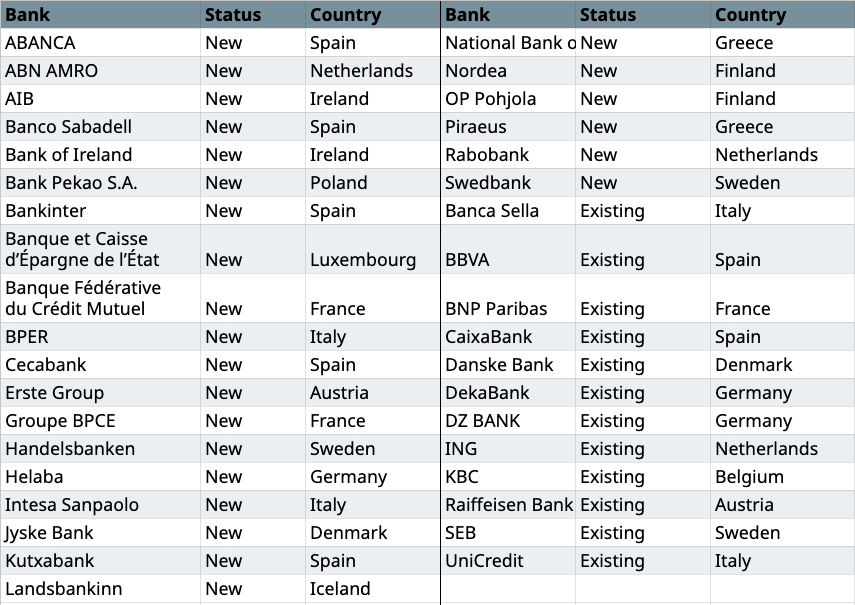
Kevalis, a European banking consortium developing a regulated euro stablecoin, expanded to 37 member institutions on Wednesday after adding 25 new banks in 15 countries.
New members include: ABN AMRO, Rabobank, Nordea and Intesa Sanpaolo. The Amsterdam-based consortium is targeting a launch in the second half of 2026, according to a statement shared with Cointelegraph.
“We are not just building payment lines; we are ensuring that European principles around data protection, financial stability and regulatory stringency are built into the next generation of digital money,” said Howard Davies, Chairman of Kevalis’ Supervisory Board.
The move comes as European institutions race to create alternatives to stablecoins dominated by the US dollar, which currently account for 98% of the market, according to CoinGecko.
Spain leads the wave of new banks
Spain emerged as the most represented country among Kevales’ 25 new members, adding five institutions, including ABANCA, Banco Sabadell, Bankinter, Cecabank and Kutxabank.
The country’s strong presence comes alongside broader signs of early adoption of euro-denominated stablecoins, with Brighty data recently pointing to Spain as a leading retail market for Circle’s EURC use.
Source: Kevalis
Two new Italian banks have joined the consortium. France, Sweden, Greece, the Netherlands, Finland and Ireland also added two new members, highlighting the broad participation in northern and southern Europe.
The diversified expansion furthers Kevalis’ goal of creating a unified and regulated euro stablecoin infrastructure within the EU Crypto Asset Markets (MiCA) framework.
The European Central Bank’s position contradicts stablecoin payments
The consortium’s plans come at a time of renewed debate in Europe about the role of private stablecoins in supporting the euro’s global standing.
European Central Bank (ECB) President Christine Lagarde said in early May that stablecoins were not the best path for Europe to strengthen the euro’s international role, opposing calls to respond to US dollar-backed stablecoins with their euro counterparts.
Despite this situation, bank-led initiatives like Qivalis continue to gain momentum as institutions seek regulated alternatives to dollar-dollar stablecoins.
Related to: Augustus CEO says banks can’t rebuild for AI and stablecoins
The consortium has been engaging with cryptocurrency exchanges ahead of the planned launch of the Euro stablecoin.
In March, Kevalis selected Fireblocks, a digital asset custody service provider, for its tokenization technology, wallet and custody infrastructure, along with tools that support compliance.
“The euro is Europe’s currency, and must be carried by the on-chain financial infrastructure – built by European institutions and governed by European rules,” said Jan Celle, CEO of Kevalis.
magazine: The eToro founder timed Bitcoin’s rise to the top perfectly due to his belief in 4-year cycles